Browser control room
Inspect the delivery state visually.
Projects, planner packets, runs, approvals, artifacts, evidence, and closeouts share one inspectable surface with explicit blocked and failure states.
Technical overview / 01
Brigata is a governed software-delivery operating environment. It keeps human intent, architecture, parallel agent work, external effects, evidence, and acceptance inside one recoverable control loop.
Implemented operator surfaces
Brigata currently ships a browser control-room surface and an Ink terminal operator preview. Both are clients of the coordinator model; neither is a worker terminal with permission to bypass policy.
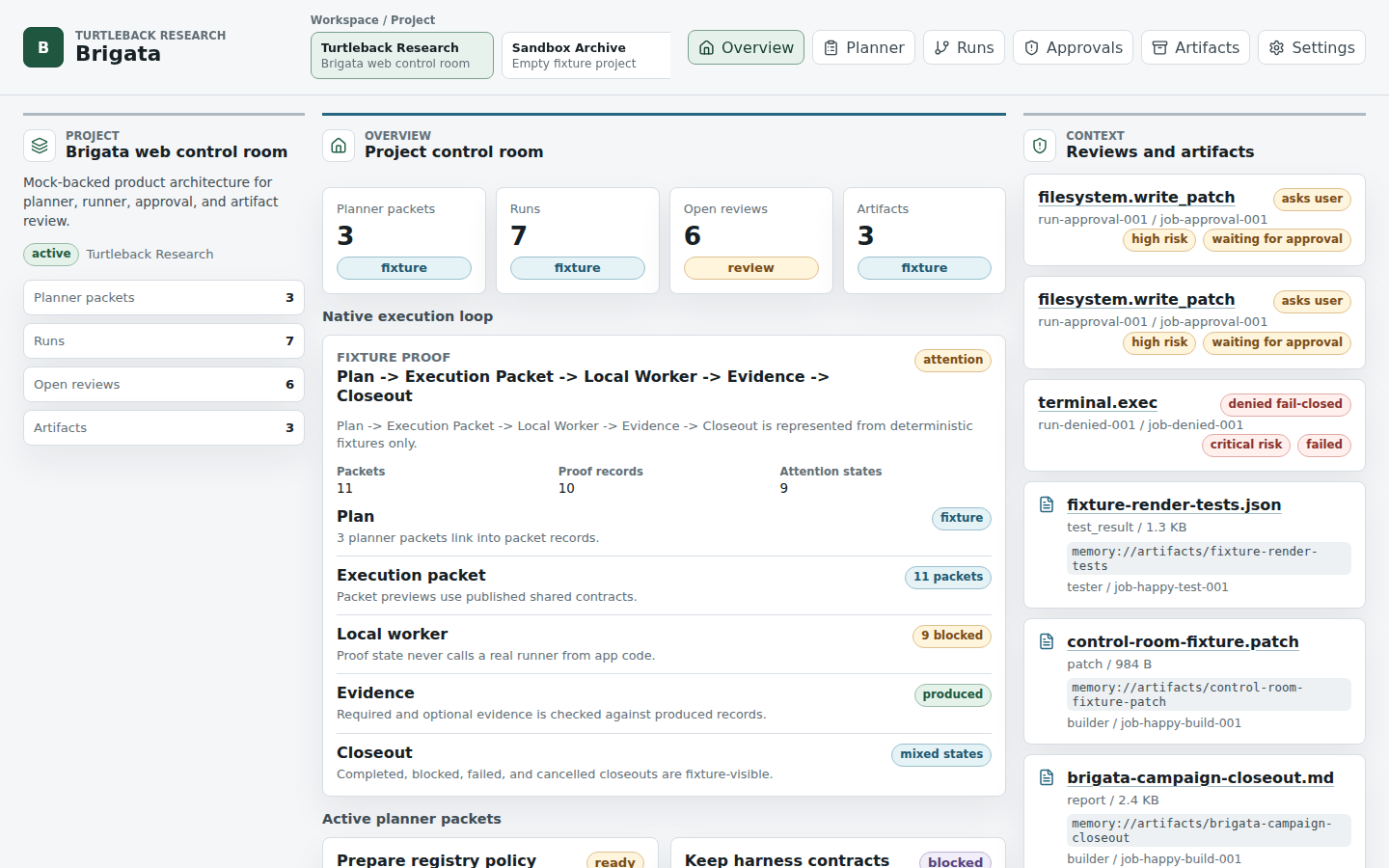
Browser control room
Projects, planner packets, runs, approvals, artifacts, evidence, and closeouts share one inspectable surface with explicit blocked and failure states.
Terminal operator console
The Ink TUI uses the same coordinator view-model boundary for run selection, attention queues, approvals, evidence, and safe pause, resume, or kill controls.
corepack pnpm tuiThe operating model
This separation lets Brigata use capable coding agents without granting any individual session authority over the delivery as a whole.
Human-approved intent
Turns a desired product outcome into bounded work, explicit acceptance criteria, and an architecture proposal a human can inspect and approve.
Durable project truth
Owns the plan, contracts, claims, dependencies, policies, budgets, effects, evidence, and current admissible state of the delivery.
Bounded worker effects
Adapts coding agents and tools into governed work: isolated scopes, controlled context, explicit permissions, and terminal receipts.
The delivery protocol
“The agent finished” is an observation, not a product verdict. Each stage must leave the state required to admit the next one.
A human accepts the outcome, boundaries, and definition of done.
→Architecture and design-security roles define the system and challenge risky assumptions.
→Interfaces, ownership, dependencies, and acceptance obligations become explicit before parallel work.
→Builders receive bounded context, isolated workspaces, and only the authority required for their scope.
→Terminal receipts, contract realization, and dependency evidence determine what may advance.
→Admissible work is assembled against the accepted aggregate rather than merged by optimism.
→Security, tests, functional review, and product gates produce authoritative verdicts.
→A human accepts the evidenced result; decisions, artifacts, and residual risk remain durable.
→Durable coordination state
Brigata represents the delivery explicitly so humans, agents, and restarted processes can recover the same authoritative state.
Defines the outcome and the boundaries autonomous work may not silently rewrite.
What are we actually building?
Give parallel scopes stable interfaces, ownership, and obligations before implementation starts.
Where may each worker change the system?
Prevent overlapping ownership and release work only when its required evidence exists.
What may run now, and against which truth?
Record attempted external work so completion, retry, adoption, or uncertainty can be reconciled after interruption.
What happened outside the coordinator?
Preserve causal history without collapsing distinct faults into a generic pipeline error.
Why did the system advance or stop?
Separate worker success from governed acceptance through tests, reviews, receipts, and explicit gates.
What proves this result is admissible?
Operational projection
Each work item occupies exactly one governed state, derived from claims, dependency evidence, gate verdicts, and durable effects. Status surfaces are read models over the same event journal that admits dispatch—so a report cannot drift from delivery truth, and uncertainty stays visible instead of rounding up to green.
The scope is admitted to the work graph with frozen contracts, and no claim is held yet.
approved intent · contract setA worker holds the scope's claim and produces effects inside an isolated worktree.
claim record · dispatch policyA dependency's required evidence does not exist yet, so the coordinator refuses release.
dependency edge · missing verdictA terminal receipt has returned and security, test, or functional gates have not yet decided.
worker receipt · queued gatesThe scope's gates signed their verdicts against recorded runs.
signed verdicts · test artifactsA gate refused the result, or an interrupted effect cannot prove its outcome. The item holds fail-closed.
typed failure · preserved uncertaintyAssembled evidence is ready for the human who owns the outcome.
delivery receiptAuthority boundary
A projection grants no authority: it cannot dispatch work, approve gates, or mutate coordination state. Standups and PMO reviews consume the same view the operator surfaces read, and keep the work that needs humans—decisions, priorities, and risk.
Interruption is normal
Processes restart. Networks break. A worker can finish after its caller disappears. Brigata treats those conditions as governed lifecycle states rather than excuses to guess.
A worker, command, or coordinator is interrupted while work may still exist.
The event journal and durable effect records restore the last authoritative state.
Receipts and external evidence determine whether work completed, can be adopted, or remains unknowable.
Brigata advances, retries within policy, requests intervention, or fails closed. It does not invent success.
Fail-closed by design
When Brigata cannot establish an authoritative result, it preserves the uncertainty and stops or intervenes according to policy.
Customer-controlled execution
Brigata coordinates the delivery. Customer code, credentials, workers, builds, and tests remain on infrastructure the customer controls.
Customer environment
Brigata authority
Model-flexible by architecture
Worker engines are adapters beneath Brigata’s authority. The current governed runtime is built around Cline, with Claude Code CLI available as an optional adapter; future engines must prove their execution, audit, and recovery contracts before adoption.
Operating patterns
Scale changes the number of people, repositories, and delivery streams. It does not change the authority model: humans approve direction, Brigata coordinates, workers execute, and evidence earns acceptance.
Solo operating pattern
One developer can supervise specialized architecture, implementation, security, and verification roles without carrying the entire delivery state in memory or chat history.
Team operating pattern
Founders, engineers, reviewers, and agent workers share the same architecture, ownership, dependency, policy, and evidence model across parallel work.
Approved intent → durable coordination → bounded effects → authoritative evidence → human acceptance
Category boundary
Pressure-test the system
Whether you are one developer supervising an agent team or an engineering organization operating them across products, bring us a real delivery problem and we will compare it honestly with Brigata's current capabilities.